
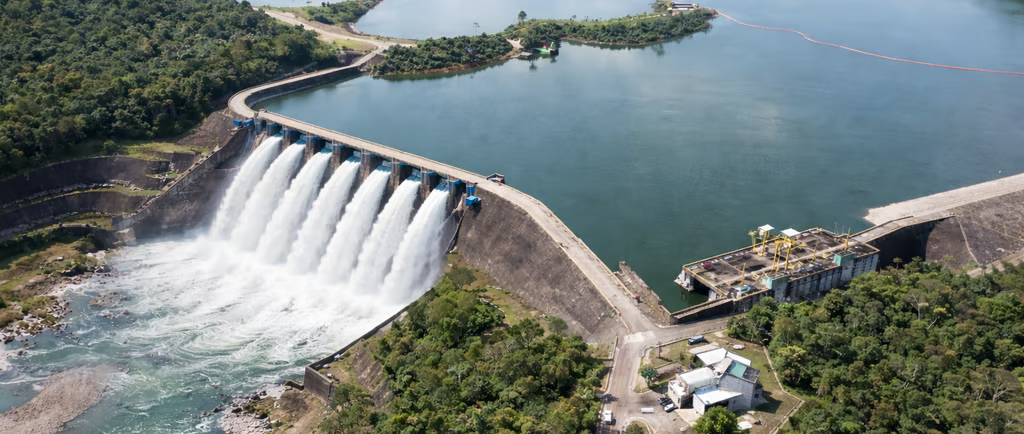
The situation currently affecting the department of Córdoba, as a result of flooding associated with atypical climate events, calls for a broader discussion about the control and management of water resources within Colombia’s power system.
Water is a public and strategic resource. Its operational management for electricity generation lies with companies that have made legitimate investments to provide an essential service and that, naturally, should receive adequate compensation. The question is not whether they should be compensated, but whether the current institutional framework optimally aligns economic incentives with the public interest in managing a strategic resource.
Beyond the specific causes of the current events—which will need to be clarified by the relevant authorities—the key issue is that climate variability can no longer be treated as an exceptional phenomenon. Periods of intense rainfall and prolonged drought are likely to become more frequent in the coming years. If the management of water resources and the operation of the power system do not fully incorporate this new climate reality, situations like the one Córdoba is experiencing today could cease to be exceptional and become a recurring feature of the country’s operating environment.
In a predominantly hydropower-based system, the decision to store water or generate electricity is not neutral: it has economic implications. Under the current market framework, retaining water in reservoirs can be a rational financial strategy, particularly when periods of greater scarcity and higher electricity prices are expected.
The structural question is whether these intertemporal incentives are fully aligned with the optimal management of climate and territorial risks. Are there sufficient mechanisms to ensure that storage and generation decisions respond not only to expected future price signals, but also to system-wide considerations of water and energy security?
In a context of increasing climate variability, this discussion is no longer theoretical. If coordination is not sufficiently robust, the country could face growing tensions between economic efficiency and risk management.
During periods of water spillage, when the marginal cost of the water resource is close to zero, another fundamental question arises: does the price-setting mechanism actually reflect this abundance? Does it make sense for electricity prices not to transmit that signal to consumers when there is excess water? In any efficient market, abundance should be reflected in prices.
Technical analyses by IVY-POLEN indicate that more coordinated and system-wide reservoir management could generate significant efficiencies for both the power system and its users, with the potential to substantially reduce electricity tariffs. This does not mean disregarding generators’ rights over the electricity they produce. Rather, it means opening a discussion about how the underlying water resource is managed and how individual incentives can be better aligned with collective well-being.
This is neither an ideological nor a short-term debate. It is a structural one. Are we dispatching electricity in the best possible way for the country? Is the current model prepared for the power system Colombia will need over the next 20 years? Are we optimizing the system as a whole, or simply each market participant’s position within the existing rules?
In a system characterized by a high share of hydropower, increasing penetration of variable renewable energy, and greater climate uncertainty, it is worth reassessing whether the current operation and dispatch model is equipped to respond to these new conditions.
If you would like to learn more about the technical analyses behind this discussion, they are available at polentj.org