
Colombia has abundant solar and wind resources that could transform its electricity mix. However, this potential still faces barriers in a regulatory, planning, and market framework designed for a predominantly hydrothermal system. That system met the country’s needs 30 years ago, but today it requires reforms to respond to current demands. The gap between what Colombia could achieve and what it currently does is the common thread connecting four new publications that are now available.
The publications are the result of joint work by the Stockholm Environment Institute (SEI), POLEN Transiciones Justas, and the Ivy Foundation, with funding from UK Partnering for Accelerated Climate Transitions (UK PACT). Each addresses a different area and, together, they provide a comprehensive perspective—from lessons learned across the region to decisions that Colombian authorities can take now.
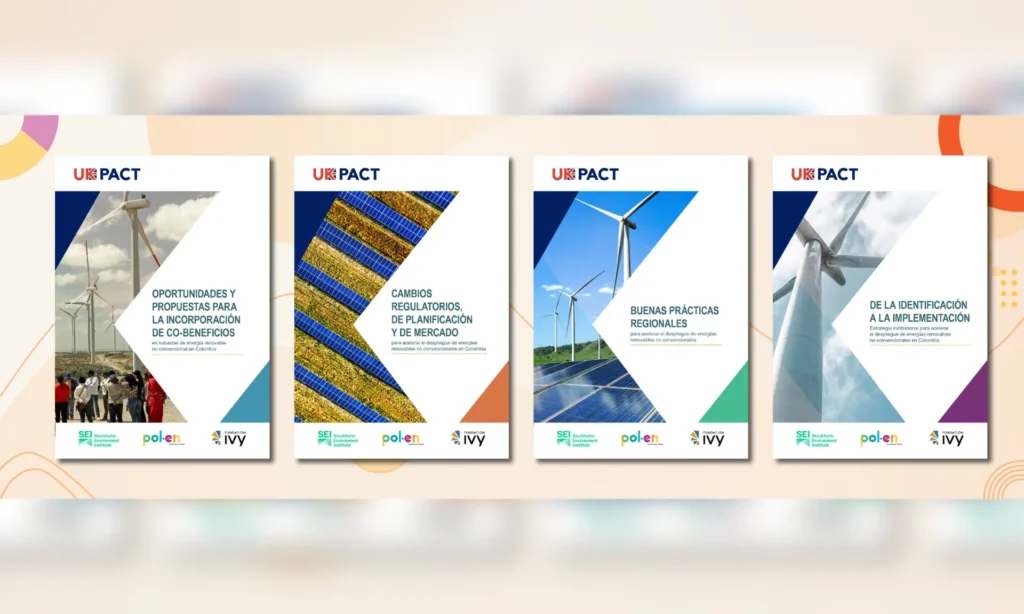
- Regional good practices brings together lessons from Latin America and the Caribbean on integrating non-conventional renewable energy and identifies the political, planning, and regulatory conditions that enabled other countries to move forward.
- Regulatory, planning, and market changes applies those lessons to the Colombian context. It shows that an electricity mix with a high share of renewables is economically optimal, technically feasible, and operationally reliable, and identifies the adjustments needed in market design and planning to sustain this pathway.
- From identification to implementation takes the next step, showing how many of these adjustments can be implemented using the powers already held by the Ministry of Mines and Energy, CREG, and UPME. The challenge is not to create new instruments, but to activate existing ones in a timely and coordinated manner.
- Co-benefits in renewable energy auctions adds a social dimension. It proposes that auctions gradually evolve to recognize, in addition to price, factors such as local job creation, gender equity, and territorial development. These measures are not intended to impose additional burdens on the sector, but rather to help reduce risks and strengthen the positive impact of projects in the territories.
From comparative evidence to an institutional roadmap, these four publications provide useful resources for policymakers, researchers, and those working on the energy transition at the territorial level.