
A draft decree from Colombia’s Ministry of Finance and Public Credit proposes updating the definition of industrial users that are exempt from the “surcharge,” or special contribution, applied in the electricity sector. This surcharge is a key source of funding for the electricity subsidies received by the country’s most vulnerable households. Understanding the background to this proposal, its implications, and the challenges it raises is essential at a time when discussions on tariff justice and the energy transition are increasingly intertwined.
Since 1994, Colombia has subsidized electricity consumption for households in socioeconomic strata 1, 2, and 3, up to an average of 173 kWh per month. This threshold is known as subsistence consumption and represents a basic minimum level of electricity use for low-income households.
To finance these subsidies, an additional 20% contribution was introduced on electricity tariffs for households in strata 5 and 6, as well as for commercial and industrial users. However, since 2013, an exemption has allowed certain users classified as “industrial” to avoid paying this contribution.
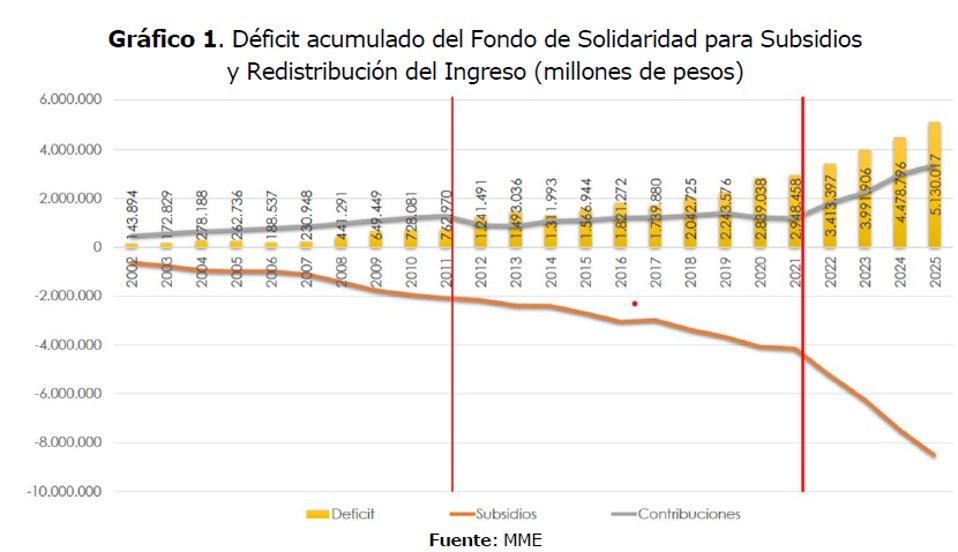
Over time, this structure has proven insufficient. The contributions collected are not enough to cover the full cost of the subsidies, creating a growing deficit that must be financed through the National General Budget. For 2025, as shown in the graph below taken from the explanatory memorandum accompanying the draft decree, this deficit is expected to exceed COP 5 trillion an amount equivalent to the cost of building more than 23,000 social housing units.
In response, the draft decree seeks to redefine the exemption by limiting it exclusively to the manufacturing industry. The aim is to better target the benefit and correct what is currently an uneven distribution of the fiscal burden. At present, a significant share of the cost of the exemption benefits sectors such as mining and quarrying, as shown in the following table, also taken from the explanatory memorandum.
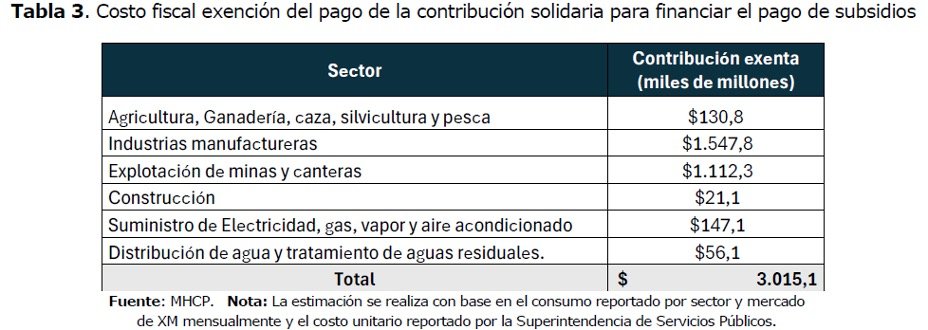
If the decree is adopted as proposed, sectors such as agriculture, mining, construction, and companies such as Ecopetrol would lose the exemption and would have to begin paying the solidarity contribution. This would imply a 20% increase in their unit electricity costs. With this change, the Ministry of Finance expects to raise more than COP 1.4 trillion in additional revenue for the Energy Subsidy Solidarity Fund (FSSRI), which finances subsidies for households in strata 1, 2, and 3.
At POLEN Transiciones Justas, we recognize that this measure could introduce a more progressive distribution of the burden of financing the FSSRI. In particular, sectors such as coal mining and oil which largely export their products and already benefit from multiple tax incentives would be required to contribute more to financing subsidies, in line with their economic capacity.
However, we also caution that the reform could generate unintended impacts on sectors that are making efforts to electrify. Actors currently shifting away from polluting fossil fuels such as diesel, fossil gas, or coal toward electricity could see those investments discouraged by higher electricity costs. This includes strategic sectors such as agriculture and ICT, which have been promoted as pillars of productive diversification in the country.
The proposed change could also create indirect effects that are not considered in the explanatory memorandum and have received little attention in the public debate. By removing the exemption, affected industries would have a strong incentive to adopt more efficient processes and self-generation technologies. For example, in Casanare’s agro-industrial sector, the payback period for a self-generation project could fall from almost four years to less than three.
One side effect of this shift toward renewable self-generation and distributed generation could be a reduction in the number of companies contributing to the FSSRI, potentially undermining the goal of increasing revenue. This highlights the need to advance structural measures that promote both energy efficiency and the democratization of self-generation, rather than focusing exclusively on temporarily increasing the fund’s income.
One of the most promising structural alternatives is to accelerate the implementation of programs such as Colombia Solar. These schemes allow lower-income households to receive subsidies in the form of self-generation systems that are paid for once and can operate for 25 to 30 years. This contrasts with the current model, under which a recurring monthly subsidy is provided indefinitely to a growing number of users.
At the same time, the Ministry of Mines and Energy (MME), CREG, and the energy sector as a whole still have work to do on implementing permanent demand-response mechanisms. These mechanisms would allow all end users—including residential households—to receive real incentives to consume electricity more efficiently, thereby reducing pressure on the system and the fiscal burden associated with subsidies. So far, such initiatives have been limited and short-term, such as the “Apagar Paga” program implemented during the 2015–2016 El Niño event.
In short, this draft decree on the solidarity contribution does more than propose fiscal adjustments. It reopens a deeper debate about equity, sustainability, and the direction of Colombia’s energy policy. The fundamental questions remain: Who should finance the social electricity tariff, and according to what principles? How can the electricity burden on the country’s lowest-income households be reduced without creating a fiscal deficit or encouraging inefficient energy use?
To better understand many of the concepts mentioned here—such as “solidarity contribution,” “subsistence consumption,” “demand response,” and “self-generation”—see the Just Energy Transition Regulatory Glossary.